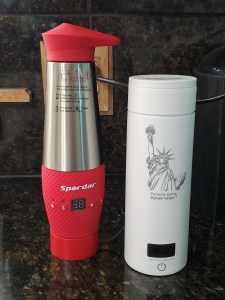
It’s been a minute, that means time for a new kettle review. This week I’m taking a look at two kettles, both from Spardar. The first is a 12v kettle that draws 120w and can be plugged into your car’s 12v outlet. The second is a 300w kettle that uses 110v house current.
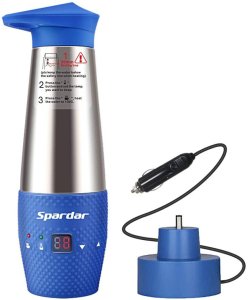
The advantage of the 12v kettle is that you can power it with your car. This is handy if you don’t have any other power source, but it’s the slowest way to heat your water, and your car needs to be on while you use it or you might run down your battery. It takes between 12 to 16 minutes to boil the water, which is heated to 100 degrees Celsius (212 fahrenheit). As soon as the water reaches this temperature, the kettle will beep and turn off. There is also a warm setting if you’d like to keep the water warm. I don’t recommend putting a beverage (such as coffee that’s already made) in the kettle to heat it, because the kettle opening is small so it will be difficult to clean. You could also ruin the exposed heating element inside.
The kettle fits about 12oz of water but the indication on the outside states that you shouldn’t fill it to the top. When I put 12oz of water in it, the kettle overflowed when I opened it. On my second attempt at using it, I unscrewed the lid but left it on the kettle. It took the same amount of time to boil and didn’t spill over. I recommend filling it with only 10oz if you plan on closing the lid, or leaving the lid open. The final thing to note is the form-factor. The kettle can sit in your vehicle’s cup holder when not in use, but you might have to remove the base with the plug if your cup holder is narrow. I’d also be concerned with constantly bending the cord since that can lead to a short. It’s better to set the kettle and base on a flat surface while heating water.
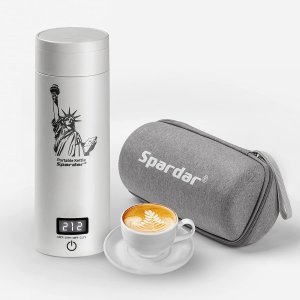
The 300w kettle from Spardar was newly released in 2022. It comes with a nice canvas case that zips up snugly and protects the kettle. You’ll need to store the power cord inside the kettle, since there’s no room for it in the case. It has four temperature settings in Fahrenheit (140, 175, 195, 212). These are supposed to be for milk, tea, coffee, and hot water, and takes about 5 minutes. I had originally thought this kettle might be good for heating soup, but the directions say you shouldn’t put anything other than water in the kettle. The inside is stainless steel and there are no exposed elements inside, but the opening is too narrow for even my small hands, so you’d have to clean it with a bottle brush and might not be able to clean it well. I didn’t try to heat milk in it for this reason. This kettle uses 110v current, so if you don’t have a wall outlet, you’ll need a power station that can supply 300w or more.

The most important thing to know about heating water and wattage is that it takes the same amount of energy to heat a cup of water whether you apply that current slowly or quickly. Think of it like gas and distance. If you are going a distance of 50 miles, it will take the same amount of gas if you drive 50mph or 25mph. You can also think of a power station like a gas tank. If it has a capacity of 300wh for example, and you plug in something that draws 300w for an hour, you’d use up all your power. Of course no one is going to run a kettle for an hour, but if you’re also using the power station to run a fridge all day when you’re camping and your car is off, that’s about 50w for every hour your car is off, so you’ll need to recharge it with a wall plug or solar panels.
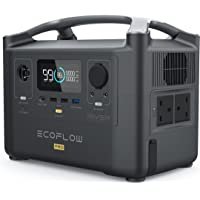
A small 300Wh power station costs about $300, but the price relative to capacity is constantly going down, so I recommend getting one that’s 500Wh or more if you can afford it. Recently, the Rockpals 500wh power station was $469 after a discount on Amazon. My favorite power station, the EcoFlow River Pro has a capacity of 720Wh and was recently $550 on Amazon. It charges to 80% in an hour, so you could take it into a cafe or McDonald’s for quick charging on the road. It also has a unique feature called X-boost that will run devices that normally require higher wattage at a lower wattage. It won’t work for everything, but it’s great when you need to run something like a hair dryer. My favorite kettle is rated at 850w, but I use it with the EcoFlow at 600w. It boils enough water for two cups of coffee in about 3 minutes.
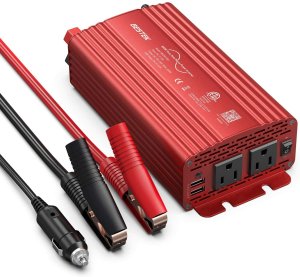
There’s one other way to power your appliances on the road, but it’s more involved than using power stations and requires some expertise to avoid killing your vehicle’s battery, not to mention electrocution. You can attach an inverter directly to your starter battery using jumper cables, or hard-wire some cables to the starter battery, or to an external battery. They range from small units that pull 300w to large units that can draw 2000w or more. The caveats are that your vehicle needs to be running, or you’ll kill your battery very quickly. And if you don’t have wire thick enough for the needs of the inverter, you could cause a short. I recommend talking to an RV dealer about having them install it, and making sure they use a circuit breaker so that the breaker would cut off the power if you ever exceed the limits of your inverter. Last, NEVER, EVER, try to run an inverter that’s rated for high wattage using your vehicle’s 12v outlet. You will cause a short, and might even cause a fire.
So if I had to choose between these two kettles, I’d choose the 300w kettle because it’s faster and has a case. I also like that I can fill it with more water, since I make large cups of coffee, and I hated the way the 12v kettle overflowed. But your needs aren’t my needs, so if you’re sure you’ll never buy a power station or inverter, and you don’t mind the wait, the 12v kettle might be for you.
Happy travels!
To keep up with my posts, follow me on WordPress, or Facebook at https://m.facebook.com/pg/tinyprius/posts/ and Instagram at https://www.instagram.com/tinyprius/

 Tiny Prius Travel
One thought on “A Tale of Two Kettles”